"Hail to the Chief"
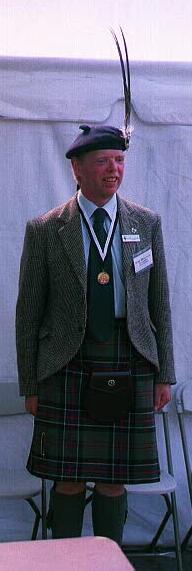
I am extremely pleased to introduce to you the Hereditary Chief of Clan Sinclair....a man of true character and vision......... Meet the Hereditary Chief of Clan Sinclair, Lord Caithness,
The Right Honorable The Earl of Caithness, Privy Councillor in Britain. We are indeed fortunate to have a person of such stature as our Chief at the helm. Don't forget to visit the "Photo Gallery" for photos of the Chief at the Stone Mountain Games in 2000 and 2001! What delightful visits. Hats off to you, Chief Malcolm, Honorable Sir!********BIO********
Born on 3rd November 1948, Malcolm Ian Sinclair, the Lord Berriedale (the title given to the eldest son) he inherited the earldom and that title following the death of his father, Roderick, the 19th Earl of Caithness, in 1965.
Roderick (Roddy) was a distinguished soldier in the British Army with the Gordon Highlanders (now amalgamated with the Queen's Own Highlanders (Seaforth and Camerons). He rose to the rank of Brigadier and as such led his regiment (part of the 51st Highland Division) through France, Belgium, Holland and into Germany during World War II. He was decorated with the CBE and DSO and after leaving the Army was appointed the Regiment's Colonel. His first wife, by whom he had three daughters (Jean, Margaret and Fiona), died during the war and after it, in 1946, he married a widow Gabrielle Ormerod, whose husband had been killed on active service in Africa leaving her with a daughter (Susie). In 1947 while posted to Germany another daughter (Bridget), was born and the next year in Burma, Malcolm was born. Roderick's next posting was to Ceylon (now Sri Lanka) where for three years he was given the position of Command of their Army with responsibility for the training of their officers to take over from the British ones following independence from a colony. On returning to the UK he was given various postings in England and Scotland before in 1955 being appointed factor (land agent and manager) of Her Majesty The Queen's private Estate at Balmoral, Aberdeenshire where he lived until his death.
Malcolm spent the better part of his childhood at Balmoral and went to the local village school before, in British fashion, being sent to a boarding school when aged eight. It was a very happy childhood in a large family and he was fortunate to have been brought up in such an attractive part of Scotland with so many outdoor sports and activities readily available. When he was thirteen, he was sent to another boarding school, Marlborough College in Wiltshire, England and which his father had attended. This was quite a contrast from what he had been used to in Scotland and so the holidays became even more precious. His father died when he was sixteen and Malcolm then became the Earl of Caithness. The title dates from 871 when Caithness, Orkney and Shetland were part of the Norwegian Realm and Rognvald, Jarl (Prince or Earl) of Moeri was granted the title of Earl of Caithness and Orkney by King Harald of Norway. In 1455 King James II of Scotland, with Caithness, but not yet Orkney and Shetland under Scottish rule regranted the peerage of the Earl of Caithness to William Sinclair. That is why Malcolm is both the 58th Earl (including the Nordic dynasty) and 20th under Scottish law and hereditary chief of Clan Sinclair.
Following his father's death his mother was granted a "grace and favor" apartment in Hampton Court Palace by The Queen and this became the new family home. Although originally destined for the Army, Malcolm decided that was not the career for him, but he would follow his father's latter career and become a factor in Scotland. Before going to the Royal Agricultural College, Cirencester, to be trained he worked for a year on the Duck of Buccleuch's estate at Drumlanrig, Dumfriesshire, on land that was probably once owned by his ancestor William, the Earl in 1455, when he was also Lord Nithsdale. He also spent a year traveling and working abroad in the U.S.A., Australia, and Africa. Having completed the three-year course at Cirencester, Malcolm worked for a firm of land agents in Oxfordshire, England, to obtain his final qualification. Following his marriage in 1975 he decided to carry on working in Oxfordshire and following a change of jobs, began working part of the time in London and soon shifted his business life full time to London. His hereditary peerage game him the right to sit in the House of Lords and politics soon became an important feature in his life, together with his business. In 1984 his career changed again when Mrs. Margaret Thatcher, the Prime Minister, invited him to join her reforming government. He started as a Whip and Lord in Waiting to The Queen before progressing to an Under Secretary of State at the Department of Transport and then Minister of Sate at, successively, the Home Office, Department of Environment, the Treasury, the Foreign and Commonwealth Office and back to the Department of Transport. He is the only hereditary peer this century to have served in the three great Department of State (Foreign and Office Offices and Treasury) and while in the Treasury was also Paymaster General. He was created a Privy Councilor to Her Majesty The Queen in 1990.
After his wife died in 1994, he resigned from Mr. John Major's government to spend more time with his children Iona and James. The Lady Iona Sinclair was born in 1978 and after schooling in Oxfordshire spent a year traveling and working in Australia, New Zealand, and Africa. She has finished her schooling at Edinburgh University where she received a zoology degree. James, The Lord Berriedale (known as Berrie) was born in 1981. After attending school in Wales he traveled to Bosnia , Africa, Australia and the U.S.A. Berrie then went on to Aviation School to obtain his private pilot’s license.
Malcolm has once again taken an active part in politics from the backbenches in the House of Lords. Also, he is now dedicating much of his time to the Clan with the creation of the Clan Sinclair Trust for the preservation of Castle Sinclair/Girnigoe. He has attended many of the Highland Games in the USA as “Honored Guest” and as “Chieftain of the Games”.